

“Tremble, tremble, the witches have returned”. Magic cauldrons, dark potions, pointed black hats, and flying broomsticks, this is the image that immediately comes to mind when we think of witches, a stereotypical depiction that has been passed down to us since we were children. But what are the true origins of these “creatures of the night”? And which places are linked to the stories and legends surrounding them?
A bit of etymology
The word strega (witch) derives from the Latin “strix” a demonic, nocturnal bird that, according to legend, fed on the blood of children. During the Middle Ages, the witch once a nocturnal bird was reimagined as a woman endowed with magical, supernatural powers. According to popular belief, she was capable of causing illnesses, casting evil spells, and performing sorcery.
In 1487, the Malleus Maleficarum, a text that classified witchcraft as heresy, was written. It served as a handbook for trials, legitimizing the capture, torture, and even the execution of alleged witches who were, in reality, wise women and healers with a profound knowledge of herbs condemning them to be burned at the stake.
If you’d like to learn more, join us on this dark journey to discover 7 of the most “witch-related” places in the world!


Salem, Massachusetts
Few places are as closely associated with witches as Salem! In 1692, the Massachusetts colony became the setting for one of the most notorious episodes of persecution in American history, which culminated in trials and death sentences. Today, Salem has transformed this chapter of its past into a cultural and tourist experience; as you stroll through the town center, you’ll encounter esoteric shops, tarot card readers, and spaces dedicated to various spiritual traditions.
Not to be missed are the Witch House, a XVIIth-century home linked to Judge Jonathan Corwin, who was involved in the 1692 trials and the Salem Witch Trials Memorial, a site dedicated to the victims of the witch trials, where stone benches are engraved with the names of those convicted and the dates of their deaths.

Pendle Hill, England
We are in the northwest of England, in the year 1612. What is striking about the events that took place here is that many of the women accused of witchcraft eventually came to truly believe they possessed magical powers. This is the case of Alizon Device. One day, she asked a peddler if she could buy some pins from him, but the man, fearing she might use them for some dark spell, refused. Alizon then wished for him to suffer a stroke, which is exactly what happened. The man survived and chose not to report her, but Alizon herself turned herself in to the authorities, having convinced herself that she had indeed caused his misfortune.


Zugarramurdi, Spain
In the Pyrenees of Navarre, near the French border, lies Zugarramurdi, a small village that has become famous for its connection to witchcraft. What makes Zugarramurdi a unique destination is the renowned Cueva de las Brujas, the “Witches’ Cave.”
It is a natural cavity shaped by water: a rocky passage traversed by a stream, through which light filters in. The cave is associated with the tradition of nocturnal gatherings of witches, known as “akelarre” (sabbats). In the early XVIIth century, these gatherings fueled by an atmosphere of superstition and fear triggered an extensive campaign of persecution, leading to investigations that ensnared many local inhabitants. The accusations centered on nocturnal rituals, secret meetings, and alleged pacts with the devil.
Zugarramurdi retains the charm of a traditional Basque village, characterized by stone houses with light-colored facades, sloping roofs, and a rural landscape of meadows, forests, and hills.
Vardø, Norway
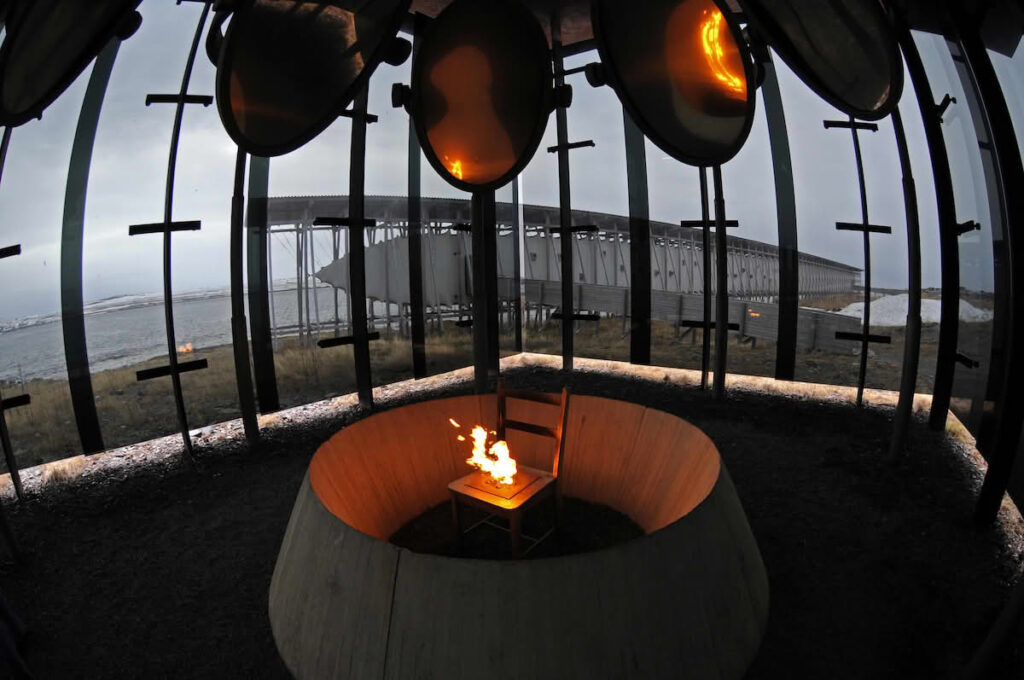
Located in northern Norway, beyond the Arctic Circle, lies the town of Vardø. Between the XVIIth and early XVIIIth centuries, it served as the setting for numerous witchcraft trials. The persecutions were particularly harsh and fell most heavily upon women. Today, Vardø is home to the Steilneset Memorial, a stark, somber monument overlooking the sea, designed by artists Louise Bourgeois and Peter Zumthor to commemorate the victims of these trials.


Pendle and Lancashire, England
In 1612, twelve people from the Pendle and Samlesbury areas were accused of witchcraft in a series of events that went down in history as the “Pendle witch trials.” One of the accused died before the trial; of the eleven who stood trial, ten were convicted and executed, while one was acquitted. The charges included alleged acts of sorcery, mysterious deaths, and encounters with the devil. The testimonies were shaped by the beliefs of the era and by complex social dynamics.
To gain a better understanding of the history of the Lancashire witches, a visit to Lancaster Castle is essential. This medieval castle overlooks the city of Lancaster and, for centuries, served as a fortress, a courthouse, and a prison. In 1612, those accused in the Pendle witch trials were brought to Lancaster to stand trial. The castle is, therefore, one of the locations most closely linked to this historical episode.

North Berwick, Scotland
North Berwick is located on the east coast of Scotland. Here, in 1590, during the reign of James VI of Scotland, who would later also become King of England, several individuals were accused of participating in secret meetings and witchcraft rituals. According to testimonies gathered by the authorities, some of the accused allegedly attempted to summon storms to endanger the ship carrying the monarch and his wife, Anne of Denmark, as they returned from Scandinavia. The accusations spread rapidly, leading to interrogations, confessions extracted under torture, and convictions. The authorities interpreted the alleged magical practices as a threat that was not only religious but also political.
Not far from North Berwick stands Tantallon Castle, a medieval fortress perched on a cliff overlooking the sea. While the castle was not the site where the primary interrogations of the North Berwick witch trials took place, it is certainly worth a visit.


Põlva and Estonia
Põlva is located in southeastern Estonia, in a region rich in forests, waterways, and small villages. In traditional Estonian lore, magic was deeply intertwined with daily life and the natural world, often linked to the figure of the healer. Medicinal herbs, orally transmitted incantations, seasonal rituals, and beliefs regarding spirits were deeply rooted in the culture of rural communities. Certain individuals were believed to possess the power to heal, protect livestock, or ward off misfortune; others were feared, as they were thought capable of causing illness or calamity.
Witchcraft trials also occurred in Estonian territories, particularly between the XVIth and XVIIth centuries. These accusations were shaped by religious beliefs, communal tensions, and a fear of events that were difficult to explain. In Estonian folk tradition, trees and various natural features were often regarded as places of spiritual significance. Certain sacred trees were associated with ritual practices and the collective memory of the community.
To travel “in the footsteps of the witches” is to immerse oneself in a world defined by superstitions, collective fears, social conflicts, religious tensions, discrimination, prejudice, and persecution. And to discover that, behind the pointed hats and “magic potions,” there were in reality only ordinary individuals gifted with a particular sensitivity, healers, and lovers of nature and all its manifestations. And you have you ever visited a place in the footsteps of witches?